Has anyone fitted an external switch to isolate their inverter? How did you do it please?

MisterB

LIFE MEMBER
Joined
Feb 25, 2018
Posts
10,624
Likes collected
36,295
Location
Essex
Funster No
52,564
MH
Adria 670 SLT
Exp
enough to know i shouldnt touch things i know nothing about ....
I want to set my inverter up via relay, so it automatically becomes 'live' when not on EHU it I also then want to be able to turn the inverter off when not actually being used. I want to fit a switch with a led so I can see when it's on or off.

I identified what I thought were the wires to the switch inside the inverter but they weren't the correct wires.

Can anyone offer some sort of insight please (or offer a suggestion recommendation) where I might be able to get a switch fitted please.

Happy to pay of course!!
IMG_20221009_100444.jpg


The switch is connected to the square circuit board. I thought it was one if the red wires, but it isn't, so it might be via the ribbon connection?
 
Last edited:
Make and type of inverter would be helpful in answering your question,
 
Quick and easy.
I turn it on when I need inverter power and of when I don't
Cut the power wire from the batteries to the inverter. My one pokes through the side of the battery box.

 
This site contains affiliate links for which MHF may be compensated.
Quick and easy.
Cut the power wire from the batteries to the inverter. My one pokes through the side of the battery box.

Thanks, I did consider that and it's an easy option. I just wanted it to be neat and use the same sort of switch (CBE?) that are throughout the motorhome already.
 
This site contains affiliate links for which MHF may be compensated.
Thanks, I did consider that and it's an easy option. I just wanted it to be neat and use the same sort of switch (CBE?) that are throughout the motorhome already.
There are inverters with a remote on/off switch built-in. You could modify that type with a CBE switch

 
Thanks for the suggestions but I already have an inverter and don't really want to buy another one! The idolater switch would work and I could mount it discretely and it would do what I needed, but it isn't how I planned it in my head ...

Subscribers  do not see these advertisements

 
Make and type of inverter would be helpful in answering your question,
It's a chinese one with no name etc. But it is a pure sine wave 2kw/4kw max
 
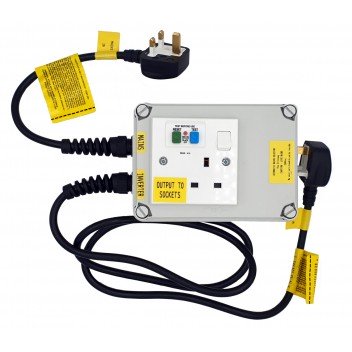
Wont this do what you are looking for?

 
Wont this do what you are looking for?

Wow! that is a touch on the pricey side! I think I need to put up the prices for my Auto Transfer Switches! (my version of that Roadpro one is £84.99)
 
Wow! that is a touch on the pricey side! I think I need to put up the prices for my Auto Transfer Switches! (my version of that Roadpro one is £84.99)
Maybe you sell many more than they do. Roadpro will take a large markup, onto of Clive's. I may well be in touch soon!
 
Wow! that is a touch on the pricey side! I think I need to put up the prices for my Auto Transfer Switches! (my version of that Roadpro one is £84.99)
Do you have an online shop?
 
I've got exactly the setup you want, but it was on the Mh when I bought it. I do know that Sterling's come with the option of a remote.

Mine has a commercial version of auto changeover I'll have a look and see if I can find a name on it. However there were threads on here years ago about how to make your own. I will have a search
 
 
Beat me to it 🤣
 
Forgive me if too obvious but is there a remote switch available for your inverter?
Mine has a telephone like plug, long cable and a simple on off with led on a remote box.
 
Forgive me if too obvious but is there a remote switch available for your inverter?
Mine has a telephone like plug, long cable and a simple on off with led on a remote box.
no there isnt. thanks anyway
 
just to clarify, i am aware of the auto switch over from EHU to inverter and actually bought the relay to do my own, following advice on here.
however what i am trying to achieve is AFTER the relay has operated and i am on 12v and the inverter is 'live' - i want to be able to isolate the inverter when its not actually need, via a switch of some sort, and then only turn on the inverter when i need to use anything that requires 240v

i understood (or thought i did) that there is a current draw through the inverter even when on standby - i was trying to avoid this as i reckon the inverter would only be required a few times per day ie, brewing up, dinner time, tea time etc so no point it running all the time and using up battery power OR is the drain that small that its not worth worrying about?
 
If I was doing it then I would use a large 12v relay to cut power to the inverter.
Then a ‘proper’ (matching) wall switch to turn the relay on/off

Very easy to do, the worst bit would be hiding wires from relay to switch In walls etc
Happy to help via PM

Andy
 
i understood (or thought i did) that there is a current draw through the inverter even when on standby - i was trying to avoid this as i reckon the inverter would only be required a few times per day ie, brewing up, dinner time, tea time etc so no point it running all the time and using up battery power OR is the drain that small that its not worth worrying about?
They do, if left on ours will switch the fan on and off because its powering the display on the microwave. We're lucky that we have a switch inside.
 
Usually the on off switch on the inverter doesn't isolate it from the 12v supply. It will still draw some current even when off. The only way is to break the 12v supply with a battery isolation switch. If you look at how thin the wires to the on off switch on the inverter are, you will see that they don't carry the high 12v current.
 
t
Usually the on off switch on the inverter doesn't isolate it from the 12v supply. It will still draw some current even when off. The only way is to break the 12v supply with a battery isolation switch. If you look at how thin the wires to the on off switch on the inverter are, you will see that they don't carry the high 12v current.
they can still be cutting a contactor

Subscribers  do not see these advertisements

 
i understood (or thought i did) that there is a current draw through the inverter even when on standby - i was trying to avoid this as i reckon the inverter would only be required a few times per day ie, brewing up, dinner time, tea time etc so no point it running all the time and using up battery power OR is the drain that small that its not worth worrying about?
The drain is small but not negligible, it definitely mounts up if left on 24/7, so your idea of only turning it on when required is a good one. The on/off switch, whether built-in or remote, will switch off most of the internal power-using circuits, and the residual drain is usually small enough to live with. If it doesn't have a remote switch facility then you'll have to turn off the switch on the inverter. The other possibility, as already said, is to isolate the 12V feed, which is probably just as inconvenient if not more so.

I suppose somebody who knew what they were doing could take the inverter apart, remove the switch and fit a connector. Then wire a switch to the connector with suitably long wires so it acts like a remote switch.
 
Last edited:
I suppose somebody who knew what they were doing could take the inverter apart, remove the switch and fit a connector. Then wire a switch to the connector with suitably long wires so it acts like a remote switch.
Which is what we did as standard back in the Nineties, then as the market moved on and upwards remote switching became the norm on better units.
 
The drain is small but not negligible, it definitely mounts up if left on 24/7, so your idea of only turning it on when required is a good one. The on/off switch, whether built-in or remote, will switch off most of the internal power-using circuits, and the residual drain is usually small enough to live with. If it doesn't have a remote switch facility then you'll have to turn off the switch on the inverter. The other possibility, as already said, is to isolate the 12V feed, which is probably just as inconvenient if not more so.

I suppose somebody who knew what they were doing could take the inverter apart, remove the switch and fit a connector. Then wire a switch to the connector with suitably long wires so it acts like a remote switch.
thanks for your suggestion, thats exactly what i tried to do - but i didnt know what i was doing LOL - i thought i had identified the correct wires ....

what i need is someone who actually knows what they are doing to offer to look at it if we are ever 'close' - though we do get to manchester a few times a year .....?????? :unsure: :unsure:

i would of course be happy to cross their palms with some coins of the realm ....
 
I use a 12v 300A isolating switch on the cable from the batteries to the inverter. Large 10mm terminals so you will need to be able to crimp the large cables or buy new leads with ready fitted terminals.

Just search on Amazon or Ebay. Price is around £10 to £15 each
 
I use a 12v 300A isolating switch on the cable from the batteries to the inverter. Large 10mm terminals so you will need to be able to crimp the large cables or buy new leads with ready fitted terminals.

Just search on Amazon or Ebay. Price is around £10 to £15 each
thanks, i know that is one option, but i just wanted a simple (small) unobtrusive switch that fitted in with the existing switches in the motorhome already.
 

Join us or log in to post a reply.

To join in you must be a member of MotorhomeFun

Join MotorhomeFun

Join us, it quick and easy!

Log in

Already a member? Log in here.

Forum posts reflect the views of individual users and not MotorhomeFun.
MotorhomeFun does not endorse or verify user-generated content.

Back
Top