Typical power use.

I turn my inverter on using the switch with neon indicator. I've used the same switch for every Renogy inverter that I've had. The new inverter charger came with the screen as shown, but I don't need another display to keep checking!
I added all the sockets and switch, also to match the existing, so who's ever idea it was, they're not on their own when it comes to aesthetics...

IMG_20261101_112707.jpg
 
The one i installed yesterday, the Renogy HF 3000w inverter/charger operates in much the same way as the 1000/2000/3000W, inverter BUT it is an inverter/charger, we dont need to turn it on when connected to the EHU, it automatically allows 'pass through' and turns on and off itself, the bonus being that if the EHU is a 'low supply' ie 3 or 6A as you might find on some continental sites, the manual says that the inverter will immediately sense when drawing more than 3/6A and will supplement the supply from the battery ..... From what i understand, that is how the Victron inverters work, i am unable to test that function so i cant guarantee it actually works, but why wouldnt it if the manual specifically states it? The new inverter also has a very simple to install N-G bonding option, its just one screw and takes 10 seconds to install!
There is a big difference between a 'stand-alone' inverter and an inverter/charger such as yours or the Victron Multiplus.

With a standalone inverter, the AC waveform is not synchronised with the hookup AC waveform, so the two supplies must always be kept separate, and can never mix.The transfer switch can automatically switch between them, if the hookup is disconnected for example, but it can never combine both waveforms.

With an inverter/charger like the Multiplus or your new Renogy inverter, the inverter synchronises itself exactly with the incoming waveform. This allows the two waveforms to mix together. So the inverter can add power to augment a low power hookup supply. It will also switch the charging off temporarily, and restart charging when the load drops low enough.

Synchonising with the hookup mains is a great feature if you frequently use a low power hookup supply, such as the ones rural sites and aires like CCP. But if you very rarely use a hookup supply, it may not be much benefit. It will be just the same as a stand-alone inverter.
 
Last edited:
autorouter - to be honest, I didn't realise it had that function to supplement the EHU supply when I bought it ....
 
There is a big difference between a 'stand-alone' inverter and an inverter/charger such as yours or the Victron Multiplus.

With a standalone inverter, the AC waveform is not synchronised with the hookup AC waveform, so the two supplies must always be kept separate, and can never mix.The transfer switch can automatically switch between them, if the hookup is disconnected for example, but it can never combine both waveforms.

With an inverter/charger like the Multiplus or your new Renogy inverter, the inverter synchronises itself exactly with the incoming waveform. This allows the two waveforms to mix together. So the inverter can add power to augment a low power hookup supply. It will also switch the charging off temporarily, and restart charging when the load drops low enough.

Synchonising with the hookup mains is a great feature if you frequently use a low power hookup supply, such as the ones rural sites and aires like CCP. But if you very rarely use a hookup supply, it may not be much benefit. It will be just the same as a stand-alone inverter.
We rarely use hook up and the only socket outlet we will have will occasionally be used for a Dyson airwrap (1600watts max), travel kettle (800W), laptop charger and a smart pot(600W), and our portable induction hob (selectable, never use full power).
These one's.
IMG_20261101_152816158_HDR.jpgIMG_20261101_152604376_HDR.jpg
BUT, again thinking of future needs.
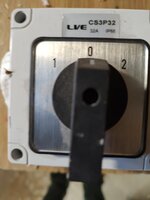
Could I wire the shore power and the Inverter through a 2 position switch then into the consumer unit. This would if course means I would have to manually select the one I want to use.
I've got this one in the pic, had it years.
IMG_20261101_153325780_HDR.jpg
Then I could wire in an induction hob if it ever came to it.
 
I think that switch is fine for switching between hookup and inverter. Especially because there is a definite OFF position in between the two supplies, so the two can never be mixed, even for a fraction of a second. I presume it's a 2 pole switch, that switches both live and neutral.

The Victron inverter you mentioned already has an earth-neutral bond, which will allow an RCD to work correctly. That earth-neutral bond will be isolated from the hookup mains side, which already has its own earth neutral bond in the hookup post. So it avoids the possible problem of two earth-neutral bonds at the same time.

I suggest you get a mains socket tester that has an 'RCD Test' function. Most of them don't but a few of them do. Then you can test your final setup, to be sure the RCD works and the wiring is correct.
 
If you are wiring the inverter output into the consumer unit, you need to split the consumer unit into Inverter Loads and Non-Inverter Loads. Non-inverter loads include the charger - you don't want the charger to be powered by the inverter, charging the battery, which is sending power to the inverter. There may be other loads that you never want to take from the battery/inverter, such as a 3-way fridge, which can drain a battery very quickly, and is best run on gas when not on hookup.

Maybe the consumer unit is already separated like that - I can see there is a 6A MCB and a 16A MCB.
Thanks for your input.
My fridge/freezer is 12V compressor type only and pulls an average of 2.2Ah, won't ever be fed from the inverter.
Will check my socket tester for RCD test function and also check the consumer unit to see if it can have split loads.
If it hasn't, can I use either of those in the pics as an inline RCD for a stand alone Inverter spur ; bearing in mind that for the foreseeable future I only want to supply one double pole socket outlet.
Having said that, it would be good to have Inverter or shore power option even though we rarely use EHU when away from home.
At home, I occasionally need to use EHU to charge the battery.
IMG_20261101_152345705.jpgIMG_20261101_152300586_HDR.jpg
 
If you are wiring the inverter output into the consumer unit, you need to split the consumer unit into Inverter Loads and Non-Inverter Loads

I achieved that by adding a relay that is only activated when the EHU is actually providing power. If EHU is connected BUT not providing power then the relay doesn't open the circuit (with one socket only) that powers a battery charger. So when using battery power only the charger doesn't operate.
The relay is rail mounted within the consumer unit.
My needs are simple based on how we use the van.
First I'll check the consumer unit to see it's configuration.
I suspect the consumer unit will be standard with one input to the main switch feeding the 2 circuit breakers. If so I would gain nothing by putting the 3 way switch before it
If that's the case I may go leave it alone and fit the Inverter as stand alone feeding only the socket outlet.
I could use either if the units in the pics below as an inline RCD. Do you think that would be OK
IMG_20261101_152345705.jpgIMG_20261101_152300586_HDR.jpg
 
Those RCD fused spur units are intended for UK house circuits, for wiring a spur from a ring main. They are not appropriate for a mobile installation that needs double pole switching devices everywhere. The RCD is double pole, but the fuse is obviously only single pole.

If you are thinking of a box like that, then a small 'garage' consumer unit with a double pole RCBO and MCB would not be all that much bigger.

You could even use a double-pole RCBO, which is a combined RCD and MCB in one unit. But then you would have to be careful, because most RCBOs in UK DIY stores are single pole, intended for house wiring.
This one for example is suitable for a motorhome. It's Double Pole, Type A, Bi-directional, B curve.
 
Last edited:
Those RCD fused spur units are intended for UK house circuits, for wiring a spur from a ring main. They are not appropriate for a mobile installation that needs double pole switching devices everywhere. The RCD is double pole, but the fuse is obviously only single pole.

If you are thinking of a box like that, then a small 'garage' consumer unit with a double pole RCBO and MCB would not be all that much bigger.

You could even use a double-pole RCBO, which is a combined RCD and MCB in one unit. But then you would have to be careful, because most RCBOs in UK DIY stores are single pole, intended for house wiring.
This one for example is suitable for a motorhome. It's Double Pole, Type A, Bi-directional, B curve.
Had a look at it, yes it would do the job and I have a small adaptable box just right for it.
That may well be the way to go, much simpler.
 
I can't (won't) comment on the technical bits as it's above my pay grade, though keeping it simple is always a good process ..
 
Those RCD fused spur units are intended for UK house circuits, for wiring a spur from a ring main. They are not appropriate for a mobile installation that needs double pole switching devices everywhere. The RCD is double pole, but the fuse is obviously only single pole.

If you are thinking of a box like that, then a small 'garage' consumer unit with a double pole RCBO and MCB would not be all that much bigger.

You could even use a double-pole RCBO, which is a combined RCD and MCB in one unit. But then you would have to be careful, because most RCBOs in UK DIY stores are single pole, intended for house wiring.
This one for example is suitable for a motorhome. It's Double Pole, Type A, Bi-directional, B curve.
Is a 10A module OK though, heaviest current is likely to be from a portable induction hob at 1800W. (About 7.5A I think).
Mind you we never use full power on an induction hob.
All other items we're likely to use will be below that and we'd have to be careful not to use 2 things at same time.
I'm thinking of a 2000W Inverter.
 
A 10A breaker is supposed to be able to carry 10A 24/7 without tripping. It will only trip if the amps rises to above 10A, if there is a fault for example. So 7.5A for an appliance is fine.

With a 2000W inverter, chances are you would never trip a 10A breaker even if you tried, the inverter would probably cut off before the breaker tripped.
Thanks, Looks like I'll be going for a Fogstar Gen2 300A battery but looking at chargers on 13V planet website the Victron 25A charger (IP67 blue smart) I fancied is recommended for lead acid batteries in the range 150-250A and MAY be suitable for smaller Lith batteries. I could message them to get info on what they mean but can you shed any light on this. Will normally just be using it when at home and can wait as long as it takes to charge, never any hurry at home.
I'm also fancying a Durite 2000W inverter from 13V.
Any thoughts on this one much appreciated.
Looks like I'll be finalising my choices in the next week then ordering.
 
It depends on which inverter you buy. the 1000/2000/3000W inverters can be wired to the consumer unit and automatically supply power from the EHU with nothing else to do in terms of switching it on. Its often referred to as 'pass through'. The only time you need to switch them on, is when you're not on EHU and relying solely on power from the battery.

You don't need to wire them to the consumer unit, they can just as easily function independent of 'mains' power, converting battery DC to AC, but of course they would need to be switched on. The power they supply is accessed via the UK style plugs fitted to the inverter itself. You would also need to check as to whether you needed to install a N-G bond for when connected to the EHU.

The one ive just removed MUST be turned on to allow 'pass through', it is the PCL 3000w inverter/charger ..... note the difference, the PCL is an inverter/charger whereas the initial ones i mentioned are purely an inverter. The PCL also requires a N-G bond for when connected to the EHU

The one i installed yesterday, the Renogy HF 3000w inverter/charger operates in much the same way as the 1000/2000/3000W, inverter BUT it is an inverter/charger, we dont need to turn it on when connected to the EHU, it automatically allows 'pass through' and turns on and off itself, the bonus being that if the EHU is a 'low supply' ie 3 or 6A as you might find on some continental sites, the manual says that the inverter will immediately sense when drawing more than 3/6A and will supplement the supply from the battery ..... From what i understand, that is how the Victron inverters work, i am unable to test that function so i cant guarantee it actually works, but why wouldnt it if the manual specifically states it? The new inverter also has a very simple to install N-G bonding option, its just one screw and takes 10 seconds to install!

Although i am VERY happy with the new inverter so far, i am reluctant to recommend it until its been put through its paces ...

FYI i know that Vanbitz/Wattguardz install the Renogy Rego version (not sure what the difference actually is?) so perhaps the new Renogy inverter/chargers are starting to challenge the long established and reliable Victron Multiplus range at a much less cost??
I bought a Renogy 3,000 watt inverter, not inverter/charger, with pass through for £207 just over a month ago.
I never go on hook up so having to switch the pass through on isn't an issue or not having a built in charger.
I've had 3 x 3 night trips away since fitting and it performs fine.
I think it's sine wave might be cleaner than my previous 2,000 watt inverter as it doesn't interfere with the portable radio I sometimes use in the lounge like the old inverter did.
 
At the moment my EHU is connected to this consumer unit.
View attachment 1281255Which is then wired straight through to the Sargent charger.
If I go the route of separate inverter and charger then I'll simply swap to a Lithium compatible charger.
For 240V I was thinking of an Inverter fed by the battery via an on/off switch then straight through to the only double socket outlet we would have, via an inline RCD. The metal clad in post #1 is only single pole and I've now got a double pole black socket outlet on order to replace it (it goes with our colour scheme). Daft I know but not my idea.
Hence the inline RCD.
Our needs will be very simple.
The inverter won't be a regular use item.
Unless.....as I said before about the diesel hob if it ever knacked up.
I think you may find that once you've got LifePo4 and an inverter you will start to use more electric items :LOL:
 
I bought a Renogy 3,000 watt inverter, not inverter/charger, with pass through for £207 just over a month ago.
I never go on hook up so having to switch the pass through on isn't an issue or not having a built in charger.
I've had 3 x 3 night trips away since fitting and it performs fine.
I think it's sine wave might be cleaner than my previous 2,000 watt inverter as it doesn't interfere with the portable radio I sometimes use in the lounge like the old inverter did.
I've previously had the 3000W Renogy inverter and it was a cracking bit of kit. I would be more than happy to recommend that particular inverter for your type of use. I think that your inverter is one of the best for the price!

PS on your inverter you don't need to do anything re pass through as it automatically happens. If you do go down the path of connecting to the mains though, you may need to add a N-G bond that only operates when you are on EHU.
 
Last edited:
I've previously had the 3000W Renogy inverter and it was a cracking bit of kit. I would be more than happy to recommend that particular inverter for your type of use. I think that your inverter is one of the best for the price!
Only 9 nights use but it seemed a solid bit of kit when I got it out of the box. Reasonable build quality, satisfying weight.
Time will tell but it was only £207 quid.
 
Speaking to Sargent about a 12v circuit failure on my PSU, I mentioned I was going to fit a 628a fogstar lithium battery and a 3000w Renogy inverter, they said do not have the inverter connected directly to the power supply as this could cause problems,so to make it really simple I brought the 240v from the inverter to 1 side of a double socket,then cut the power wire out of the PSU (that supplied the sockets around the kitchen)
to the other socket, a plug was connected to the
cut kitchen circuit, so just swap plug left for
Inverter right for hook up.
So far so good and no chance of the inverter getting accidentally connected to the PSU.


20261102_214347.jpg
 
Looks like I'll be going for a Fogstar Gen2 300A battery but looking at chargers on 13V planet website the Victron 25A charger (IP67 blue smart) I fancied is recommended for lead acid batteries in the range 150-250A and MAY be suitable for smaller Lith batteries. I could message them to get info on what they mean but can you shed any light on this. Will normally just be using it when at home and can wait as long as it takes to charge, never any hurry at home.
I have a Victron IP67 Bluesmart charger, the 15A version, charging my 150Ah Ecoflow lithium leisure battery, and it works fine. I think the first issue is that it might take a very long time to charge a large flat battery, but it sounds like that isn't a problem for you. Also some of the cheaper chargers are not built to charge for a very long time at full blast. But this is a Victron charger, so no problem there.
 
the Victron 25A charger (IP67 blue smart) I fancied is recommended for lead acid batteries in the range 150-250A and MAY be suitable for smaller Lith batteries

have a Victron IP67 Bluesmart charger, the 15A version, charging my 150Ah Ecoflow lithium leisure battery, and it works fine

Happy Jack I'm just about to remove a 15A Victron Blue smart IP67 if it's of any interest. I have it operated by a relay so it only charges when on EHU (along with solar and a soon to be fitted small B2B)
 
I have a Victron IP67 Bluesmart charger, the 15A version, charging my 150Ah Ecoflow lithium leisure battery, and it works fine. I think the first issue is that it might take a very long time to charge a large flat battery, but it sounds like that isn't a problem for you. Also some of the cheaper chargers are not built to charge for a very long time at full blast. But this is a Victron charger, so no problem there.
Thanks, have messaged 13V planet to see what they say about suitability of the charger.
My Sargent charger(not suitable for Lighium) is 20A and I was looking for at least 20A or more.
I like Victron and this night be first time I've mentioned but I'm also getting a Victron B2B.
The only fly in the ointment is Victron Phoenix inverters seem expensive.
Looking at Sunshine Solar products.
As it happens I got their own brand Solar panels and AGM batteries as well as the Sargent charger and Victron MPPT off them 5 years ago.
The AGMs are still OK even though thev'e been below 50% a good few times.
For what it's worth I rate Sunshine Solar inverters and it will be the brand that replaces my new Renogy inverter should it fail.
As you are fitting a Fogstar battery have you considered a Fogstar charger ?
2 friends are using them with no issues, 1 using a 20 amp and 1 using a 50 amp.
The 20amp is noisy in use but it is one of Fogstars old original chargers and the new model is supposed to be quieter.
The 50 amp is quieter.
Thanks, was on Fogstar website and no chargers mentioned in the menu ???
 
Folk posting that we last X or Y days and dont need any charge and still have Z left in the battery is just how they use the system.

We are all different.

So a 600 amp lithium 12 volt system will have: -
600a x 12volts devided by 1000 = 7.2 KW or at 12.8 (lithium voltage 7.68KW)
So that all you have to use.
 
Yes they are not in the main menu but if you use the search function magnifying glass it opens a page of their chargers.
View attachment 1281873
Had a look, fancy the 30A charger; but there's no mention on whether it's performance can be seen with the Fogstar app.
Would be nice if it could, or does the app see the battery and what's going into it ?
 
This exact socket in the picture is not suitable, but similar ones are available which are suitable. There are a number of issues.

First, the switches on the sockets are single pole. These are fine for UK domestic circuits, but not suitable for motorhome circuits which should have either double pole switches or no switches at all.

Next, the type of RCD (active or passive) is important. A passive RCD will stay switched on if the power fails, then comes back on. Passive RCDs are used for fridges and freezers, to avoid having to switch all the RCDs back on every time you switch the inverter on, or disconnect and reconnect the hookup cable. You probably want a passive RCD for a motorhome. An active RCD switches off if the power fails, so is safer if powering machinery, to avoid unexpected restart of a machine if power resumes after a cut.

A Victron inverters like the 1200 has the AC output neutral connected to the case of the inverter. The case needs to be connected to the vehicle chassis and the earth terminal of the socket. That will allow the RCD to function correctly, improving protection for the user if multiple appliances are in use. This arrangement is different from many other brands of inverter, which usually have a floating neutral, not connected to the case or to the earth terminal.

It's a good idea to use a socket tester with an RCD Test function to test the socket once it is installed, to check that wiring has been done correctly and the RCD works OK. Note that pressing the RCD test button on the socket itself only tests the trip mechanism, not whether it has been wired correctly.
Checked out the socket, it's an MK LNK 6233 which is double pole but have already fitted the black one as SWMBO was obeyed, it apparently stuck out like a sore thumb❤️. Pic of new one below.
IMG_20261103_123146971.jpg
Just had a thought.....appliances that we plug in will normally be on the countertop above the outlet.
Is there anything to say I can't have it upsidedown ?
 

Join us or log in to post a reply.

To join in you must be a member of MotorhomeFun

Join MotorhomeFun

Join us, it quick and easy!

Log in

Already a member? Log in here.

Forum posts reflect the views of individual users and not MotorhomeFun.
MotorhomeFun does not endorse or verify user-generated content.

Back
Top