Connecting an EHU Cable

Joined
Jan 23, 2016
Posts
2,842
Likes collected
420,493
Location
Wales
Funster No
41,434
MH
Adria Coral 660SP
Exp
25 years
Is there a correct way to do this?

Connect the van end first.

Or the supply end first?

My simple thoughts were to connect the van end first because if you connect the supply end first you are walking around with a 'live' cable in your hands.
 
Is there a correct way to do this?

Connect the van end first.

Or the supply end first?

My simple thoughts were to connect the van end first because if you connect the supply end first you are walking around with a 'live' cable in your hands.
Exactly! You've answered your own question correctly. :):)

And disconnect from supply first.
 
Upvote 0
And check polarity if you are concerned about it.
 
Upvote 0
And check polarity if you are concerned about it.

More important on the continent that over here as someone will have done it for you, a very nice man wiv da big testing meter, not some Johnny Foreigner wot don't care. ;):LOL:
 
Upvote 0
My cable is on a reel so you have to connect the 'flying end' first which is the van end. The reel then sits near the bollard, with the cable through it, so that end is disconnected first. Don't even have to think about it.
 
Upvote 0
I take the opposite view.
If you plug the lead in the hook up first and it does not trip? then you know your lead is ok. If it trips when you then plug it into the van you have a van fault.
Either way it is protected by the RCBO
 
Upvote 0
And you should also turn off the breakers in your fuse box and turn them on one at a time once connected.
Doesnt really apply in the UK on 16amp supplies but on a 6amp supply you may overload the posts trip if everything is turned on.

Subscribers  do not see these advertisements

 
Upvote 0
I take the opposite view.
If you plug the lead in the hook up first and it does not trip? then you know your lead is ok. If it trips when you then plug it into the van you have a van fault.
Either way it is protected by the RCBO

Only problem with that Andy is if your lead has a a split in it there is a chance that as you pass that damaged bit through your hand, your hand muscles will clamp shut if you get a shock, and that could be very dangerous. Always best to connect supply last, if indeed it trips it can easily be reset without the van connected to see if the lead is faulty.
 
Upvote 0
I tend not to worry to much about it, common sense is the key, check your lead for damage regularly, if your toaster is faulty don't stick a knife in it without unplugging it first.

I see the argument for plugging in the van first but walking about with a live lead is what most people do with there flymo, hair straighteners, electric drill, etc etc etc

Enjoy your holiday (that's why you bought the van)

Reverse polarity has been discussed countless times, but I've never heard of a "vanner" being electrocuted (in fact I've heard more gassing stories than electrocution stories!!)
 
Upvote 0
Only problem with that Andy is if your lead has a a split in it there is a chance that as you pass that damaged bit through your hand, your hand muscles will clamp shut if you get a shock, and that could be very dangerous. Always best to connect supply last, if indeed it trips it can easily be reset without the van connected to see if the lead is faulty.
No you should fully unwind your lead before plugging it in as good practice.
A coiled lead has less current carrying capacity anyway so uncoil ALL of it
NOT in a pile either, run the excess back and forth twixt hook up and van.
No clamping shut with RCD
 
Upvote 0
No you should fully unwind your lead before plugging it in as good practice.
A coiled lead has less current carrying capacity anyway so uncoil ALL of it

You are right of course but I never mentioned a cable on a reel, mine is loosely wound and I always throw it away from me before connecting up to either end.
 
Upvote 0
Use one of these. Your cable will last much longer without twists and tangles and you don't even need to touch it but can inspect both winding in and out.
 
Upvote 0
Use one of these. Your cable will last much longer without twists and tangles and you don't even need to touch it but can inspect both winding in and out.

Not for me Andy. Not only do I only have a small hatch to put it in, a reeled cable would be too big, but also I have had the same three cables for over 15 years without any damage or problems, bet a plastic reel won't last that long!!
 
Upvote 0
I must assume there are some fair weather only campers on this thread. :)

I've pitched and disconnected in the rain and I know which plug I would prefer to connect last or disconnect first - the supply side one. :)

And if your lead is on a reel just unroll it first. In the same way I normally drape the socket over the supply pillar or whatever it is and the lay the cable out as I walk back to the MH. Then plug it in with any excess coiled on the ground by the MH and finally connect at the supply socket.
 
Upvote 0
No need to get kinks in a cable, if you know how to coil a rope you can coil a cable even if it does tend to heavier at the final loop..

Subscribers  do not see these advertisements

 
Upvote 0
Not really connected....(excuse the pun!) but in an early life in the Army I trained as an Electrician Driver in the Royal Signals. I spent years, in all weathers, providing power to communication vehicles, tents, barns etc from large (27.5 or 50KVA) generators by laying yard after yard of mains cables. No circuit breakers for us, just good old fuses and earth spikes!
Many times we had to provide lighting in tents etc using 2 core cable with light bulb holders called "prick thoughs". Now these prick throughs had spikes that pierced holes through the insulation on the cables and we were always told to lay cables and connect bulbs BEFORE connecting to power supplies as "old holes from previous use" could be dangerous. Needless to say we ignored the rules as it was easier to have "live cables" in order that we could connect lights as we went and see what the bloody hell we were doing!!
I was shocked many times by doing this, even worse was that the more shocks we had the more we felt we were getting immune to them!! The immoral to this story is than now I'm older and seem to value what's left of my life I pay attention to good advice and don't take chances anymore!! Here endeth the lesson!!
 
Last edited by a moderator:
Upvote 0
Hooking up to the Mains

A practical guide for connection to electrical hook-ups

Introduction

The diagram and notes overleaf show the equipment you need and how to connect and disconnect your caravan or motorhome. All Club Sites and most others in the UK that are equipped for mains (see note 1) will be to international recommendations (see note 2), but abroad this may not be the case.

To be safe, an out t’s mains wiring installation should be carried out by an electrical expert (see note 3) and you should ideally have an inspection and written report once every three years (by an appropriately quali ed contractor – see note 4). A new out t will have mains wiring installed correctly if it has a National Caravan Council (NCC) certi cate (note 3).

The supplies on all Caravan Club sites are correctly protected against earth faults by a Residual Current Device (RCD – note 6)

and against over currents by miniature circuit breakers. On other sites, check before use that a similar standard of safety is provided.

The supply must be taken into the caravan by means of a lidded recessed inlet device; do not take a lead through a window to electrical equipment inside the out t.

Where site equipment is not to IEC Standard, as often occurs aboard, replace your plug with the type necessary for that site and make certain it is correctly wired up. Adaptor cables must be used with care – refer to The Club’s Caravan Europe guide.

Note for motorhome owners:

Please do not leave your mains cable connected and trailing across the pitch when leaving the site for the day. This is highly dangerous for other site users.


Caravan Club guide .. http://www.caravanclub.co.uk/media/14554860/hooking-up-to-the-mains-2014.pdf

ALWAYS in this order

Connection

  1. Check your caravan isolating switch is at ‘OFF’.

  2. Uncoil the connecting cable from the drum (a coiled cable with current owing through it

    may overheat).

  3. Take your cable and insert the connector (female

    end) into the caravan inlet.

  4. Insert the plug (male end) into the site outlet

    socket and turn it clockwise until it locks.

  5. Switch your caravan isolating switch to ‘ON’.
6 Preferably insert a polarity tester into one of

the 3-pin sockets in the caravan to check all connections are correctly wired. Never leave it in the socket. The supply must not be used if the polarity is incorrect.


Disconnection

  1. Switch your caravan isolating switch to ‘OFF’.

  2. At the site supply socket, press the release button

    and withdraw the plug.

  3. Disconnect the cable from the caravan.


    If...

    1. If at any time you do not receive power or have any other electrical problem which you do not understand a qualifed electrician may be needed, particularly if there is a fault that keeps recurring.

    2. If you overload your mains system a circuit breaker will disconnect your supply, which only site staff may reconnect.

    3. Please be aware if you connect faulty appliances to the system the safety devices may disconnect not only your power, but also to other outfits.

    4. Should a fault occur do not investigate anything unless you have disconnected from the supply. The trip in your van may need to be reset; know where to nd it.

    5. If your cable is damaged, never cut, rejoin or tape- up and never wrap any connection in polythene sheets as the condensation that forms will easily conduct live electricity.

6 Preferably insert a polarity tester into one of

the 3-pin sockets in the caravan to check all connections are correctly wired. Never leave it in the socket. The supply must not be used if the polarity is incorrect.
 
Last edited:
Upvote 0
Uncoil first, plug into EHU next and then into MH, always done it that way. When leaving do it in reverse order and check my cable (clean it) before putting away. Simples
 
Upvote 0
When I first started out with the van, I'd do either and then learnt a lesson from my mistake :(

Met up with a few friends in their motorhomes and 1 tugger (we only acknowledged him after dark :rofl:) and I plugged the lead into the supply and then the motorhome. For whatever reason the posts arced and fused together. Only the tiniest of arcs, but it did the trick :(

I didn't know this had happened until I came to unplug and no amount of tugging, swearing or pulling would release the plug :(

Had to strip the EHU from the side of the van, strip the cable and pins and eventually freed it off. Now I make sure I plug the vehicle end in first, have all the breakers open so that there is no power drawn and then plug into the supply. Only then do I flick the RCD and individual switches to power up the interior :)

Also make sure that the EHU is spotlessly clean inside the cover and I lube it with WD40, before wiping clean :)
 
  • Like
Reactions: DBK
Upvote 0
Uncoil first, plug into EHU next and then into MH, always done it that way. When leaving do it in reverse order and check my cable (clean it) before putting away. Simples

Of course you can do it your way if you wish but please don't advise new comers to do it that way round. As shown on previous posts, unlikely perhaps, but it could be dangerous.

Subscribers  do not see these advertisements

 
Upvote 0
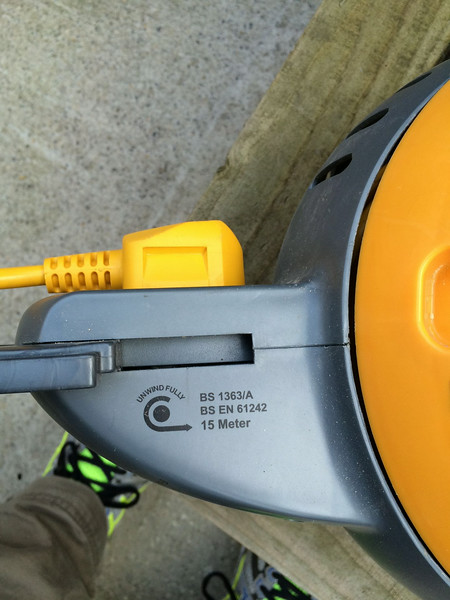
No you should fully unwind your lead before plugging it in as good practice.
A coiled lead has less current carrying capacity anyway so uncoil ALL of it
NOT in a pile either, run the excess back and forth twixt hook up and van.
No clamping shut with RCD

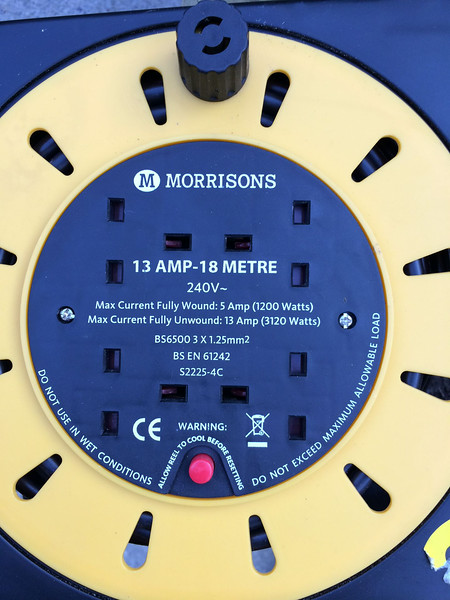
I read this in several magazines and it sounds like good sense: a wire will warm up when it has a current passing through it and as it warms up its resistance will increase, thus limiting its current carrying ability. Coils of wire in close proximity to each other will result in mutual warming, further decreasing the current-carrying ability and possibly generating sufficient heat to produce spontaneous combustion.

BUT does it really happen? o_O Can anyone offer values for resistance of 25m of copper cable, temperature & resistance rise created by 16A current? :sneaky:

My EHU cable must be over 10y old and sits outside in all weathers. It is not coiled carefully, avoiding kinks, when I wrap it up although I do keep it reasonably "straight". It has never felt warm to my touch, except when lying in brilliant sunshine. Is it, perhaps, a case of saying "avoid holidays in sunny climates" rather than "uncoil fully on UK sites"? :LOL: - Gordon
 
Upvote 0
I read this in several magazines and it sounds like good sense: a wire will warm up when it has a current passing through it and as it warms up its resistance will increase, thus limiting its current carrying ability. Coils of wire in close proximity to each other will result in mutual warming, further decreasing the current-carrying ability and possibly generating sufficient heat to produce spontaneous combustion.

BUT does it really happen? o_O Can anyone offer values for resistance of 25m of copper cable, temperature & resistance rise created by 16A current? :sneaky:

My EHU cable must be over 10y old and sits outside in all weathers. It is not coiled carefully, avoiding kinks, when I wrap it up although I do keep it reasonably "straight". It has never felt warm to my touch, except when lying in brilliant sunshine. Is it, perhaps, a case of saying "avoid holidays in sunny climates" rather than "uncoil fully on UK sites"? :LOL: - Gordon
A typical domestic extension
CA_08201418342965-L.jpg

Another UNWIND FULLY
CA_08201418354445-L.jpg
 
Upvote 0

Join us or log in to post a reply.

To join in you must be a member of MotorhomeFun

Join MotorhomeFun

Join us, it quick and easy!

Log in

Already a member? Log in here.

Forum posts reflect the views of individual users and not MotorhomeFun.
MotorhomeFun does not endorse or verify user-generated content.

Back
Top