So I have broken my brakes... now what

MiniNick

LIFE MEMBER
Joined
Sep 23, 2025
Posts
32
Likes collected
60
Location
London
Funster No
115,331
MH
Don't Own One Yet
So I was replacing the brake calipers on my Transit based Hymer 682 (2009). The rear ones done without a hitch, then moved onto the front ones and stupidly let the master cylinder run dry. :madder:

Now i am struggling to get make the pedal go firm. I have re-bled the system and then run an ABS Bleed program (via Forscan). I did hear air being pumped through the system but the pedal still remains soft and goes to the floor.

So now what..... It fortunately booked into the local ford dealership on Monday next week (to fix the aircon) but i can't really drive it there. So can i call the AA and get them to recover it to Ford? That seems the only choice.... I will try to re-bleed it yet again just to try and make sure but i guess that's the only option?
 
We just down the road from Amersham.

Yep fluid to all the calipers, the Forscan software uses the ABS system to pump fluid, and from what i understand if you let the master cylinder run dry (like i did) you get air in the ABS module. Hence running the ABS pump to get it out.

Will try to prop the pedal and see if that helps. I will give bleeding a go tomorrow (had enough for the night).
 
Sometimes reverse bleeding can work well with problematic ABS pumps, or pressure bleeding direct at ABS pump.

I guessed you’d probably had enough for the day, and doubt the pedal down trick will work with air trapped in ABS unit, but nothing to loose by trying for the night.

If you desperate and need a hand let me know, I’m about an hour away and have a few brake bleeding bits of kit, and know my way around vehicle. 👍🏻.

Sometimes it just needs a bit more pressure than just a foot press can provide.
 
Sometimes when you bleed and use full pedal travel ( where you normally dont) it can kill the Master Cylinder seal. Had that on my Ranger, there are repair kits , but its easier just to put another one on as its easy to get to and very cheap compared to everything else.
 
That happened on my Peugeot Boxer, could not get brake pressure, finally fixed by fitting a new master cylinder. I stripped it down and found internal corrosion, when bleeding the piston went through it's full stroke damaging the seal as it moved further than normal into the rough corroded area. Also a good reason to replace the fluid regularly.
 
The master cylinder can be tested by checking output, or the input into the ABS pump

It’s the reason I prefer to power, or even gravity bleed as I prevents the stress to the master cylinder.

Fingers crossed that the master cylinder hasn’t been damaged and it’s just air in the pump.
 
Thanks all for the help.

If it helps, when the engine is off the pedal is pretty solid and doesn't hit the floor.

But when you start the engine, I assume with the assistance of the vacuum, the pedal goes to the floor. With the engine running if you pump the brakes it does start to firm up a bit and then slowly drops to the floor.

Does that give any more indication of master cylinder failure versus air?
 
I think your master is ok from what you write.

Be interesting to know how the pedal feels after it’s been left overnight.
 
How are you bleeding the system?

Modern systems with ABS Pumps etc really don’t respond well to the old way of somebody pressing the pedal and another ‘working’ the Bleed Nipple.

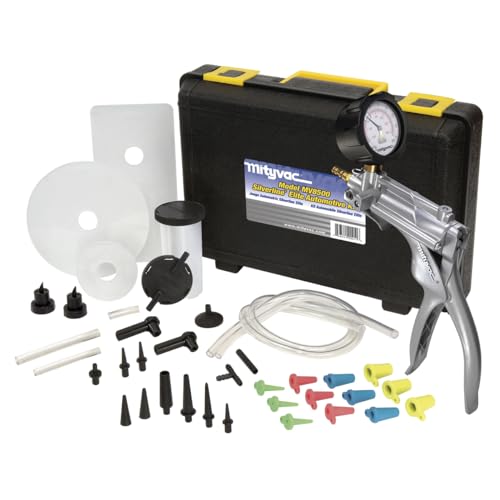
A one person vacuum type set-up to drag fluid through the system, or even pressurised system to blow it through from the master cylinder is far superior.

I use one of these which have proved excellent over the years, and been well worth the money.


However, any Vacuum or pressurised system is going to empty the Master Clyinder reservoir far quicker than doing it the manual way, so you have to be far more careful in that respect.

My big tip when using one of these is to use Plummers PTFE tape around the bleed nipple thread, otherwise when you crack it open you’ll draw a small amount of air down the side of the thread and it will look like you still have air in the system.
 
This site contains affiliate links for which MHF may be compensated.
I use one of these. No danger of air getting in as it also has a fluid reservoir and puts it in under pressure. Just open the bleed screw and in it goes.

 
This is the pressure bleeder that I’ve got. No chance of running out of fluid.

 
This is the pressure bleeder that I’ve got. No chance of running out of fluid.

That's the one I just bought.

I also have been using one way valves on the bleed tubes off the nipples as safety net. But as Desmo mentioned I might have been letting air in around the valve if I opened it too much.

I think I will give it another go tonight
 
That's the one I just bought.

I also have been using one way valves on the bleed tubes off the nipples as safety net. But as Desmo mentioned I might have been letting air in around the valve if I opened it too much.

I think I will give it another go tonight
Leaking bleed nipples won’t be a problem if you are using a pressure bleeder as you are always forcing fluid down/out. It’s a problem if doing it old school or vac from nipple.
 
I know it’s obvious but

You have fitted the callipers the correct way so that the bleed nipple is at the top.
 
I know it’s obvious but

You have fitted the callipers the correct way so that the bleed nipple is at the top.
Ha ha ha. Yes checked that twice before fitting. :LOL:

So we have some progress. Rather than following the set bleeding programme via the computer, I ran the programme on each caliper individually....... And on the last caliper you could hear the pump pushing air.

Now the pedal still goes to the floor but slower. I had to stop as the ABS pump was getting warm. So I think this might just be a game of patience to just keep bleeding it and hopefully it will sort itself. 🤞
 
Ha ha ha. Yes checked that twice before fitting. :LOL:

So we have some progress. Rather than following the set bleeding programme via the computer, I ran the programme on each caliper individually....... And on the last caliper you could hear the pump pushing air.

Now the pedal still goes to the floor but slower. I had to stop as the ABS pump was getting warm. So I think this might just be a game of patience to just keep bleeding it and hopefully it will sort itself. 🤞
Sounds like you are getting there. 👍🏻👍🏻

Sometimes if you have air in the abs unit, and keep triggering it, you can aerate the brake fluid, so will not get a good pedal. So doing a bit then leaving it is probably a good plan and have another go tomorrow.
 
I had exactly the same problem with my Vivaro. The pedal sank to the floor after changing one of the calipers.
I had a vacuum and a pressure bleeding system, the pressure system is WAY better if you are working solo, I gave the vacuum one away.
I bought an OBD device to exercise the ABS system, this didn't work. I went through 3 litres of brake fluid trying to solve it.
I then thought is must be the master cylinder so replaced that as well. Turns out the master cylinder was fine.

What finally worked was driving it on gravel/rough surface and hammering the brakes hard. The first couple of goes was ultra scary but it solved it.
I had someone watching the wheels to make sure they didn't all lock up the same at the same time and they seemed to take turns locking up and juddering at first.

I wasn't prepared to take it out on the road after doing this. So left it till the next day. It was way better then next day, but my judgement was shaky, I didn't really trust it.
But when I drove it it performed perfectly and passed the MOT a week later.

Not sure if this will help or even if it is the same problem.
 
Oh one other thing.
I was told bleed the brakes going from furthest from the master cylinder to the closest.
In the case of the Vivaro this is wrong. You start on a rear wheel, then move diagonally to the front, then back to the other rear then back diagonally to the other front.
I can't remember which one was first, depends on which side the steering wheel is on. But this made a big difference once the primary problem was resolved.
I believe this not applicable to all vehicles but depends on the ABS system in use.

The Haynes manual was wrong on this.
 
Last edited:
Thanks all for the help.

If it helps, when the engine is off the pedal is pretty solid and doesn't hit the floor.

But when you start the engine, I assume with the assistance of the vacuum, the pedal goes to the floor. With the engine running if you pump the brakes it does start to firm up a bit and then slowly drops to the floor.

Does that give any more indication of master cylinder failure versus air?
Had this effect recently after changing front brake pads. Solid pedal with engine off, pedal slowly going down with engine running. Mechanic said that’s how it works to prevent over pressure and blowing seals. Took it for a run and brakes worked fine although took a few hundred miles to bed in properly. Currently in France came over the Pyrenees from Spain yesterday, done 2.500 miles since and brakes work great. That was on a Ducato.
 
Last edited:
I had a vacuum and a pressure bleeding system, the pressure system is WAY better if you are working solo, I gave the vacuum one away.
I have to disagree.
I find the hand pumped vacuum system gives far more fine control.
You are sat at the caliper and can adjust the vacuum with one hand and bleed nipple opening with the other.

However, I suppose most of my brakes work is on motorcycles these days where perhaps the better control at lower vacuum levels helps.
But, I've used my kit very successfully on several Land Rovers I've owned, two of which had ABS pumps, including my current Discovery.
 
I have to disagree.
I find the hand pumped vacuum system gives far more fine control.
You are sat at the caliper and can adjust the vacuum with one hand and bleed nipple opening with the other.

However, I suppose most of my brakes work is on motorcycles these days where perhaps the better control at lower vacuum levels helps.
But, I've used my kit very successfully on several Land Rovers I've owned, two of which had ABS pumps, including my current Discovery.
On a van I gave myself blisters pumping the vacuum system and only got a dribble out. Remember I went through 3 litres of fluid. The pressure system pushed the fluid through quicker and I could adjust the pressure.
I started off at a lower level, and worked my way up till I was getting a healthy flow.

The pressure system tops up the brake fluid as you go so no risk of running the reservoir empty.

The pressure system paid for itself in time, energy and physical injury for me, I will never go back to vacuum :p

The vacuum system probably would have been ok if I hadn't got air into my ABS system though.

Each to their own though :)
 
So I was replacing the brake calipers on my Transit based Hymer 682 (2009). The rear ones done without a hitch, then moved onto the front ones and stupidly let the master cylinder run dry. :madder:

Now i am struggling to get make the pedal go firm. I have re-bled the system and then run an ABS Bleed program (via Forscan). I did hear air being pumped through the system but the pedal still remains soft and goes to the floor.

So now what..... It fortunately booked into the local ford dealership on Monday next week (to fix the aircon) but i can't really drive it there. So can i call the AA and get them to recover it to Ford? That seems the only choice.... I will try to re-bleed it yet again just to try and make sure but i guess that's the only option?
The AA might attend, but technically you wont be entitled to service as it's not a breakdown, its a "self inflicted fault" or as you've already worked on the vehicle they could decline service. If they do attend, it would be too heavy for the attending Patrol to move. They will try and get out of putting it up for a recovery truck as that would go against their performance figures. So, I wouldn't hold your breath for a free recovery.
 
So just for completeness of the story, bled the system again, pulling about 4l of brake fluid through the system in total. Then tentatively took the van out for a short drive and brake test and it actually seemed OK. Enough so that it could get to Ford to have a look, who thought everything was entirely fine......

I am, still slightly weary as the travel on the brake pedal still feels long, so i might change out the master brake cylinder for belt and braces as it is 19 years old now and oddly not that expensive.

But it has made it down to the west coast of France (Bordeaux) all OK so i might just be being paranoid.

Thanks for all the help and suggestions!!
 
So just for completeness of the story, bled the system again, pulling about 4l of brake fluid through the system in total. Then tentatively took the van out for a short drive and brake test and it actually seemed OK. Enough so that it could get to Ford to have a look, who thought everything was entirely fine......

I am, still slightly weary as the travel on the brake pedal still feels long, so i might change out the master brake cylinder for belt and braces as it is 19 years old now and oddly not that expensive.

But it has made it down to the west coast of France (Bordeaux) all OK so i might just be being paranoid.

Thanks for all the help and
glad you got sorted. Having experienced the same problem initially it’s concerning. Over time and as the new brakes bed in fully confidence will grow.
 

Join us or log in to post a reply.

To join in you must be a member of MotorhomeFun

Join MotorhomeFun

Join us, it quick and easy!

Log in

Already a member? Log in here.

Forum posts reflect the views of individual users and not MotorhomeFun.
MotorhomeFun does not endorse or verify user-generated content.

Back
Top