
Speed limits for motorhomes and campervans catch people out constantly. I have seen heated debates on our forum where two members were both absolutely certain they knew the correct limits, and they were both wrong. It is one of those areas where a little knowledge is worse than none, because people fill in the gaps with confident nonsense.
The good news is that once you understand the system, it is genuinely straightforward. The bad news is that the threshold that matters is not the one most people think it is.
Here is everything you need to know.
Why are motorhome speed limits different from a car's?
A standard car licence holder drives a car. Simple. The speed limits that apply are the ones posted on the signs, or the national limits for that road type.
A motorhome is legally classified as a motor caravan, and the law distinguishes between lighter ones and heavier ones. That distinction changes the limits that apply to you on some roads. Get it wrong and you are speeding, regardless of what the signs say.
The key weight threshold is 3.05 tonnes unladen. Not 3.5 tonnes. I cannot stress this enough, because 3.5 tonnes is stamped all over your logbook and the vehicle itself, so it is the figure that lodges in people's heads. But for speed limits, it is irrelevant.
What is unladen weight, and how do I find mine?
Unladen weight is the weight of your motorhome when it is completely empty. No water, no gas, no luggage, no passengers, no food, no clothes. Just the vehicle itself with all its permanently fitted equipment.
This is different from:
- MAM (Maximum Authorised Mass): the maximum the vehicle is legally allowed to weigh when loaded. This is what appears on your V5C and on the plate on the vehicle. Typically 3,300kg or 3,500kg for most UK motorhomes.
- MIRO (Mass in Running Order): the unladen weight plus a 75kg allowance for the driver. Some manufacturers also include 20kg of water and a hookup lead. This is the figure manufacturers tend to publish in specs.
To find your unladen weight, deduct 75kg from your MIRO figure. That gives you a reasonable estimate. If you cannot find MIRO, the manufacturer should be able to tell you, or you can take it to a public weighbridge.
If your unladen weight is under 3.05 tonnes (3,050kg), you follow car speed limits. If it is over, you do not.
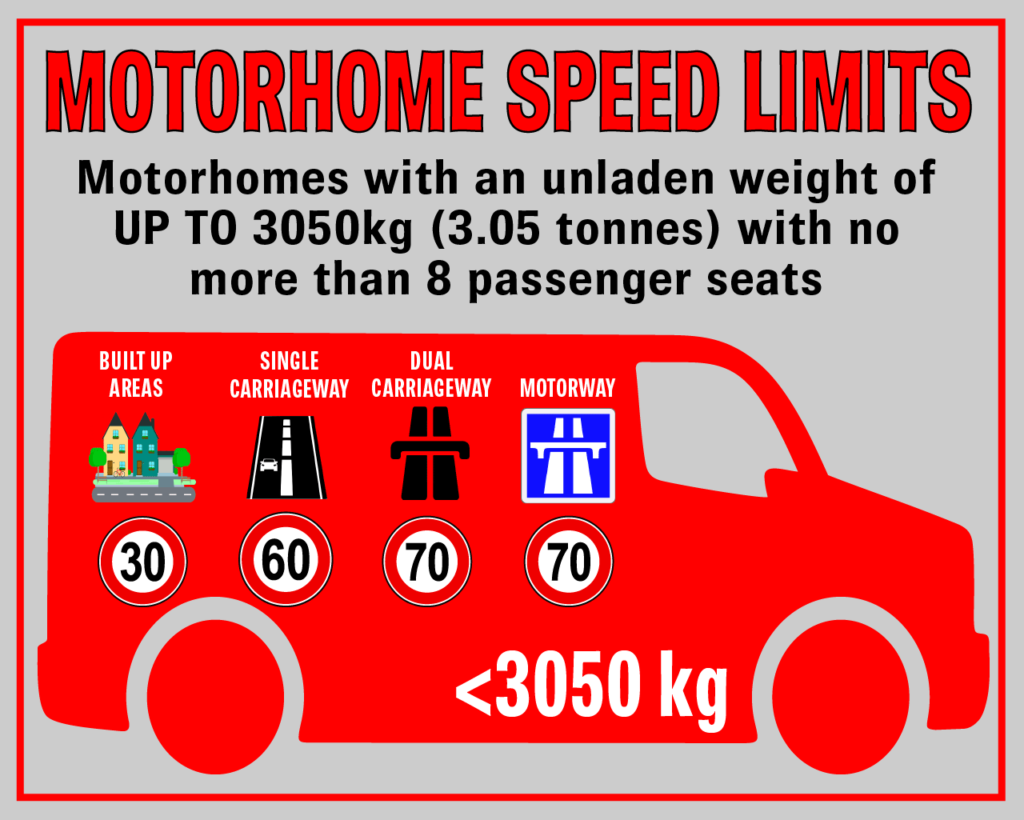
What are the speed limits for motorhomes under 3.05 tonnes?
If your motorhome's unladen weight is 3,050kg or less, the limits are exactly the same as for a car. No special restrictions apply.
| Road Type | Speed Limit |
|---|---|
| Built-up areas | 30 mph |
| Single carriageway | 60 mph |
| Dual carriageway | 70 mph |
| Motorway | 70 mph |
Most panel vans and smaller coachbuilts on Fiat, Peugeot or Ford Transit bases will fall into this category. If you are in a Fiat Ducato-based coachbuilt at 3,300kg MAM with an unladen weight of around 2,700kg, you are in the car category for speed limits. Carry on.
What are the speed limits for motorhomes over 3.05 tonnes?
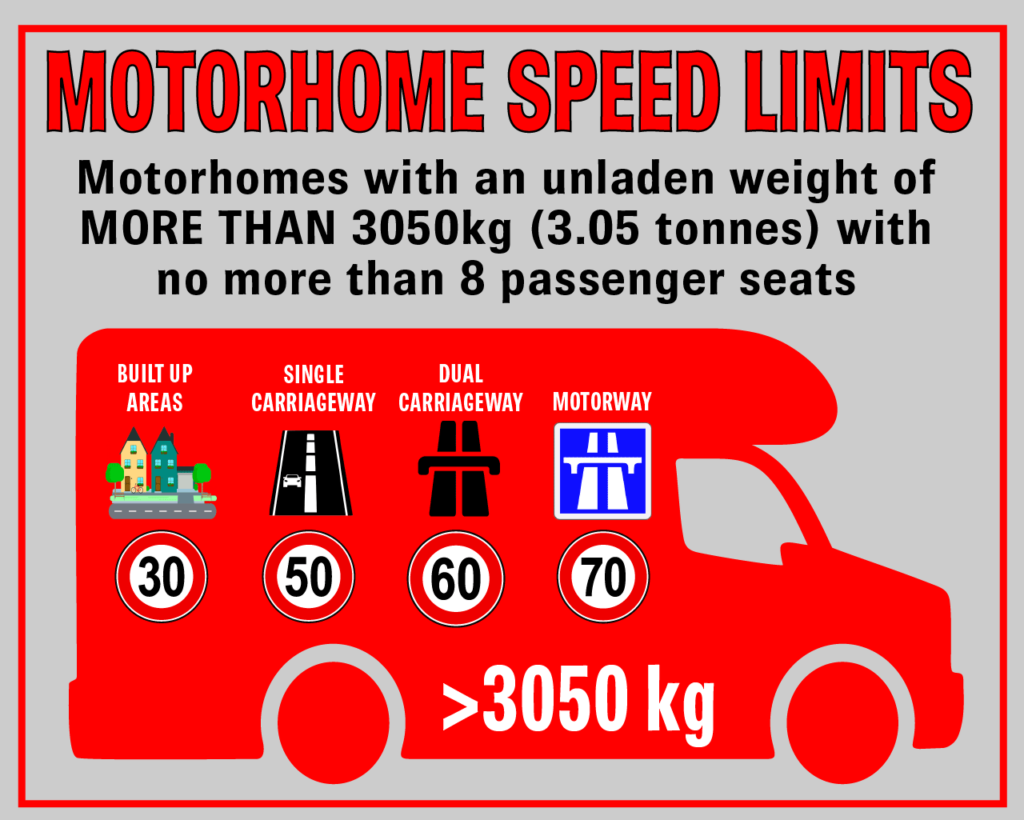
If your unladen weight exceeds 3,050kg, you are subject to lower limits on some roads.
| Road Type | Speed Limit |
|---|---|
| Built-up areas | 30 mph |
| Single carriageway | 50 mph |
| Dual carriageway | 60 mph |
| Motorway | 70 mph |
The motorway limit is the same. But on a single carriageway you are limited to 50mph, and on a dual carriageway, 60mph. If you have ever been overtaken on a dual carriageway by someone in an identical looking motorhome and wondered what they were playing at, this is probably why.
Large A-class motorhomes, tag-axle coachbuilts, and high-specification American-style RVs are the ones most likely to fall into this category.
What are the speed limits when I am towing?
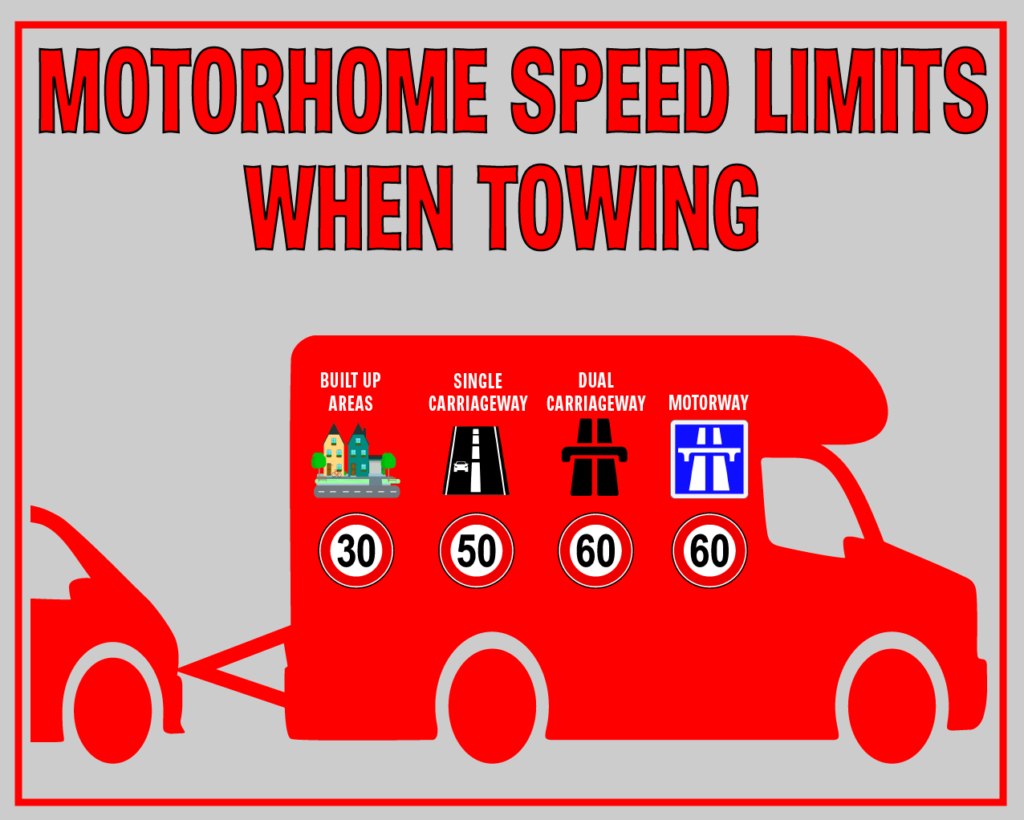
Towing a car, a small trailer, a boat or anything else behind your motorhome brings its own set of limits. These apply regardless of your vehicle's unladen weight.
| Road Type | Speed Limit |
|---|---|
| Built-up areas | 30 mph |
| Single carriageway | 50 mph |
| Dual carriageway | 60 mph |
| Motorway | 60 mph |
Notice that the motorway limit drops from 70 to 60 when you are towing. This is the one that tends to surprise people. Stay in the left or middle lanes and keep it to 60. You also cannot use the outside lane of any motorway with more than two lanes when towing.
Can I use the outside lane of the motorway?
It depends on your motorhome's unladen weight and the number of lanes.
On a three-lane motorway, a motorhome under 3.05 tonnes can use all three lanes. A motorhome over 3.05 tonnes must not use the outside lane.
On a motorway with four or more lanes, motorhomes over 3.05 tonnes are restricted to the inner lanes. Outside lane is not for you, whatever your weight.
If you are towing anything at all, you cannot use the outside lane on a motorway with three or more lanes, regardless of the vehicle's weight.
I always remind people: if you are sitting in the outside lane of a three-lane motorway in a large motorhome and feeling smug about your overtake, double check your unladen weight. You might be breaking the law.
What about very long motorhomes? (Over 12 metres)
For motorhomes over 12 metres in length, stricter limits apply on single carriageways: 40 mph rather than 50 mph. Dual carriageway and motorway limits remain unchanged at 60 mph.
If you are driving a large American RV or an extended A-class, it is worth checking your vehicle's length. Most UK buyers are not in this territory, but it catches a few people out.
What speed limits apply in Europe?
This is where it gets genuinely complicated, because every country has its own rules. As a rough guide for the most popular destinations:
France: Motorhomes under 3.5 tonnes follow car limits (130 kph motorway, 110 kph dual carriageway, 80 kph on other roads in dry conditions). Over 3.5 tonnes the limits drop, particularly on motorways. There are also reduced limits in wet weather for all vehicles. We cover France in detail in our Taking Your Motorhome to France guide.
Spain: All motorhomes are restricted to a maximum of 120 kph on motorways, regardless of weight. On secondary roads the limit is typically 90 kph for lighter motorhomes and 80 kph for heavier ones.
Germany: No general speed limit on the autobahn, but motorhomes over 3.5 tonnes are typically restricted to 80 kph on all roads. Lighter motorhomes can follow the recommended 130 kph on the autobahn, though many find this impractical in a loaded motorhome.
Netherlands: 100 kph on motorways for motorhomes, lower than cars. Check before you travel.
Always check the specific rules for each country before you cross a border. The fines for speeding in some European countries are eye-watering, and foreign-registered vehicles are not exempt.
Why does everyone think the limit is 3.5 tonnes?
Because 3.5 tonnes is everywhere. It is the MAM limit above which you need a C1 driving licence. It appears on the V5C. It is stamped on a plate on the vehicle. Speed limit signs on the roads use it for goods vehicles.
But for motor caravans, the law uses unladen weight and a different threshold: 3.05 tonnes. The two systems coexist and the confusion between them is entirely understandable.
The practical effect is that many motorhomers think they know their speed limits when they do not. If your MAM is 3,500kg and your unladen weight is 2,800kg, you follow car speed limits. If your MAM is 3,500kg and your unladen weight is 3,200kg, you do not.
Same MAM. Different limits. Find out which category you are actually in.
A quick word about cameras and enforcement
Average speed cameras and fixed cameras do not know your unladen weight. They know your speed. If you are doing 68mph on a dual carriageway in a heavy motorhome where the limit for you is 60mph, you are eight miles an hour over the limit. The camera will not care that it looked like a car speed.
I am not going to preach. I will just say: know your limits, drive accordingly, and do not assume because everyone around you is doing 70 that 70 is legal for you.
FAQ
What speed can a motorhome do on a motorway?
70 mph, regardless of weight, provided you are not towing. If you are towing anything, the motorway limit drops to 60 mph.
What is the speed limit for a motorhome on a single carriageway?
60 mph if your motorhome's unladen weight is under 3.05 tonnes (same as a car). 50 mph if your unladen weight is over 3.05 tonnes.
What is the speed limit for a motorhome on a dual carriageway?
70 mph if under 3.05 tonnes unladen. 60 mph if over 3.05 tonnes unladen.
What weight threshold determines motorhome speed limits in the UK?
3.05 tonnes (3,050kg) unladen weight. Not MAM, not the 3,500kg figure on your logbook. The unladen weight of the vehicle when it is completely empty.
Can a motorhome use the outside lane of a motorway?
Only if the motorhome's unladen weight is under 3.05 tonnes, and only on motorways with three lanes or fewer. Motorhomes over 3.05 tonnes must not use the outside lane on any motorway. When towing, no motorhome may use the outside lane on a motorway with three or more lanes.
What is the speed limit for a campervan in the UK?
A campervan used as a motor caravan follows the same rules as a motorhome: under 3.05 tonnes unladen, car limits apply. Over 3.05 tonnes, lower limits apply on single and dual carriageways.
How do I find my motorhome's unladen weight?
Look for the MIRO (Mass in Running Order) figure in your motorhome's specification sheet and deduct 75kg. If you cannot find MIRO, contact the manufacturer. When in doubt, take it to a public weighbridge.
Are European motorhome speed limits different from UK limits?
Yes, and they vary by country. France, Spain, Germany and the Netherlands all have different rules for motorhomes, and many are lower than UK limits. Always check the specific rules for each country before you travel.
It's Academic
This article will be academic to many, because like me, they do not care about that extra 10 mph. We tend to poodle along dual carriageways and motorways at around 58 mph, just enough to stay ahead of the trucks.
While writing this article I started a discussion on MotorhomeFun read it and you'll see there is plenty of confusion. None from you though, because now you know 😀
If you are new to motorhoming and finding your feet, come and join MotorhomeFun. It is free to look around, and the collective knowledge of 80,000 owners is a genuinely useful thing to have access to.

James Brown BEM is the founder of MotorhomeFun (est. 2007), the UK’s largest motorhome community, and a retired close-protection specialist. He has been motorhoming for over 35 years and is the author of The Motorhome Buyer’s Guide, The Motorhome Security Handbook, and The Bodyguard’s Bible. When he isn’t on the road, he’s at home on the Lincolnshire coast.